Hi, I’m JD Faulk.
I believe that we have a day-to-day creativity that goes largely unrecognized within ourselves.
We see shapes in the clouds and finish each others sentences. We make meals from leftovers. We are pattern-seekers and we fill in the unknown with our “what-if?” minds.
I see creative expression and adaptation as essentially the same action. We adapt to changes all the time. I find it helpful to think about creative expression as pattern completion. It’s easy to ask yourself, “what do I see now?”
If the page is blank, try putting down anything. Grab words from a magazine; Use shadows find a pattern on the wall.
Start anywhere. Put anything down. Then ask yourself: “What do I see now?”
What if sharing the patterns we see *was* considered our creative expression?
JDF 2020
P. S. Below is a bit of writing I did back in 2013.
———–
Change is constant. So is our desire for control.
We essentially tell ourselves “I won’t need to adapt to this anytime soon. The sun will rise tomorrow, I will see, hear, smell, taste, and touch familiar things. I will have a home.” Our personal routines necessarily keep us somewhat in control of things, yet, as the principle of evolution shows, our mental flexibility will continue to remain advantageous for our brains. Therefore I believe there’s a kind of biological wisdom to play because it offers a low-risk space in which to exercise our adaptive capabilities. In playing we wonder at things as they are and imagine things as they might be. Through the process of play we imbue our everyday assumptions with new mystery, awakening a curiosity for the hidden relationships found in the ordinary. We find that there are other stories behind silverware, cement, eyesight, eating animals, stoplights, the scientific method, sunlight, history, an old scar, a favorite record, an old friend, or a stranger. An idea is not an island, each one networks with a root system of potential discoveries. We perceive these everyday hidden discoveries when we approach life with curiosity. That’s what this space is about: a curiosity for how we intuit hidden relationships. Following the thread of intuition out-of-doors, across the lawn, and into the charmed forest of spontaneously related ideas. As in a dream, what follows are adventures of the unconscious mind at play.
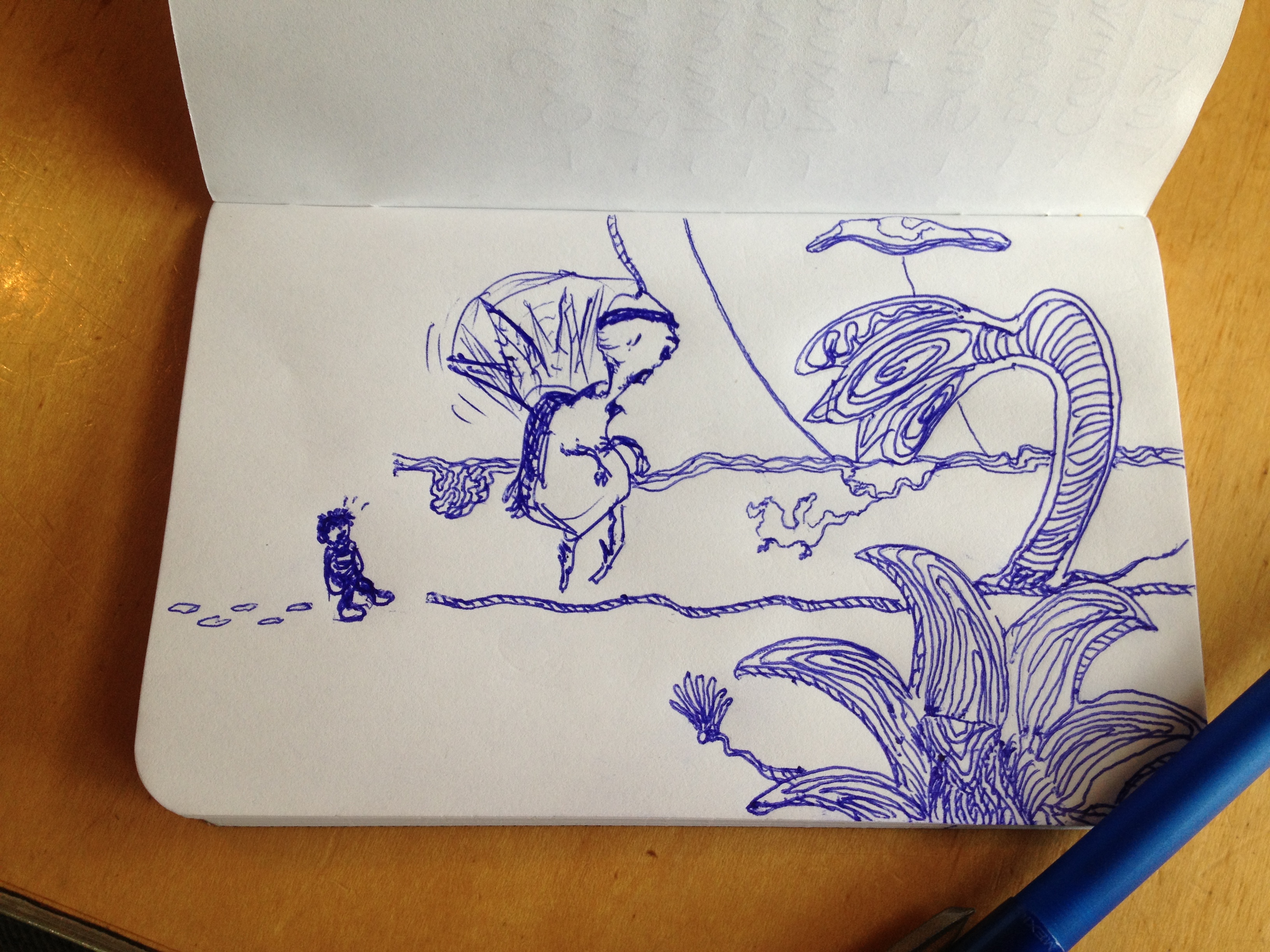 The thread connects new and old ideas.
- Prose, Poetry, & Narratives
- Drawings, Music
- Observations and Experience
What I see is that we creatively adapt to situations all the time. We find ourselves adapting to the limitations set by each circumstance like a riddle. This skill helps us get ahead in life and keeps us from stress or harm — valuable stuff. We need this ability to adapt within externally enforced norms. Yet when it comes to our desire to discover original ideas, as in art or science, we are often frustrated by the same norm-following adaptive ways that have helped us for most of our lives. So by acknowledging our continuing need to adapt to norms we can cultivate a gentleness toward that part of ourselves that wants to stay within the lines. So, “Good job, norm-following self; thanks for all that you do.” In learning how to work with that adaptive tendency we can learn to expand our creative drive because we then realize that original ideas come when we simply adapt to an imagined scenario.
I like the thought of a creative endeavor being like melted snow from a mountain top; if we simply relinquish control we’ve got the energy to be mindful of the moment and ride the fresh current.
The creative act is like our curious lion friend — an untamed part of our humanity — yet we’ll often approach the wildfire nature of the creative act with a lion tamer’s mentality. The lion tamer is partially the reflex of our adaptive norm-following tendency. But in play we want to practice opening the cage doors to let that wild observer roam for awhile. When we open that cage there’s immediately the fear of wildness and the temptation to give in to perceived control. A little voice says, “Am I doing this right?” – “Will this be any good when it’s finished?” We usually panic and pull a helicopter parent move: “Excuse me, shut it down. Too dangerous, too wild, shut it down.” We can learn to be patient with that helicopter parent and say “It’ll be okay, we’re just playing right now. It’s OK.” So let’s explore a new relationship to creativity by offering a bridge between our analytical and creative capacities. The bridge, I find, is by way of Wonder.
Wonder is an awareness of our observations that extends beyond our normal assumptions. We observe and say “Wow!” at something for its own sake. We ask “What If?” with unassuming curiosity. Creativity could be about asking “What If?” and then acting from courage to set-in-stone (for the moment) whatever answer floats to mind. Your pattern-seeking mind will automatically seek context for the raw material there, even if it has to piece together a pattern from your own imagination. A broad extension of this definition for creativity might sound like: “Finishing the pattern of what we see when there’s more than one answer”, and by that standard even mishearing someone could qualify as a creative act because we unconsciously fill in the unknown with a near-enough answer. Pareidolia is another form of everyday creativity.
Kids are superb at letting their lion observer roam through the World of Ideas. Their assumptions are so few that they can synthesize new ways of looking at things without even realizing it. Ever see a kid play with cardboard boxes? Cardboard boxes were the best toys in the neighborhood when I was a kid. If we got a cardboard box we’d find endless games to play with them. I’d often build little forts out of them, carve doors, draw computers inside, and use paper towel rolls poking through as telescopes. There’s so much opportunity for discovery with raw material like that. I think it’s because cardboard boxes don’t have a pre-packaged purpose. They’re somewhat sturdy and you can tear them up, paint on them or stack them or do whatever you want. The pattern of “how to play with a cardboard box” can be completed with as many answers as there are players, driving home the importance of re-purposed raw material in the creative act. We simply re-imagine the purpose of the material by exploring what else it could be used for — essentially we’re remixing the relationships from what’s already there by exploring one intuitive decision at a time.
Like a kid with a cardboard box, sometimes we just need some random junk to play with so we don’t feel like we’re going to break anything or use it the wrong way.
“I think playing is like praying. I think it shows the ultimate reverence for life.”
– The Junk King (Austin, Texas’ Cathedral of Junk)
Play, as in dreaming, gives us a space for our unconscious mind to breathe outside of the constant, serious business of “usefulness.” Play is a space where curious ideas in the corner of your mind might finally come forward because there is no critical operation in front of it. Newly realized connections often surface in this present-mindedness. Since ideas are free to be “useless” in the playground, this gives us freedom to fail and having the freedom to fail is the only way to create. Through play we are cultivating grace and curiosity.
I observe that a narrative often precedes action so I’m choosing to champion the fully-accessible, anytime creativity of our everyday observations. I’ve created this space as a way to share explorations through an unfolding narrative. This is one way for me to practice playing with ideas, a “What If?” adventure to be shared. I invite you to join in the discovery and to share your observations as well.
Sincerely,
JDF 2013
Follow the narrative at TrustTheThread.com

 Trust The Thread
Excellent article comrade. Creativity does seem to stem from our natural ability to want to connect the ideas from the world around us. Play is an interesting behavior because most mammals perform this behavior. It is an anticipatory, almost training-like exercise that will prepare the organism for the wild. The difference in humans (that we know of) is our gift of foresight and imagination. We can play to help us prepare for an event in the future, no matter how unlikely. They help children establish rules, ethics, etc so from the unconscious chaos comes structure in the tangible world.
An excellent read. Very astute and logical points with a dash of magic. Well done.
Jklaus
Thank you JKlaus – I particularly like the idea you mentioned of play keeping a person’s mind adaptive to an unknown future. For example, practicing martial arts, chess-playing, and writing a song are all challenges that could improve the mind’s ability to efficiently solve multi-level problems. A kid playing with LEGO could grow up to have an intuitive understanding of design and structural integrity. A kid on the playground will naturally develop a healthy relationship to the basic laws of physics. A person playing in Nature may observe the interconnectedness of life and death. Serendipity is so closely tied to discovery that we can’t begin to decipher how much we gain from wandering, observing, tinkering, exploring…
Thanks again for the feedback and the complement.
J
I like how you form thoughts on creativity. I think it’s also closely related to relaxation. I’m sitting in my classroom with a YouTube video on of the surf. I’m also eating in a different space. I do like being creative. I think it is more challenging to be mindful and giving yourself permission.