CHAPTER 1
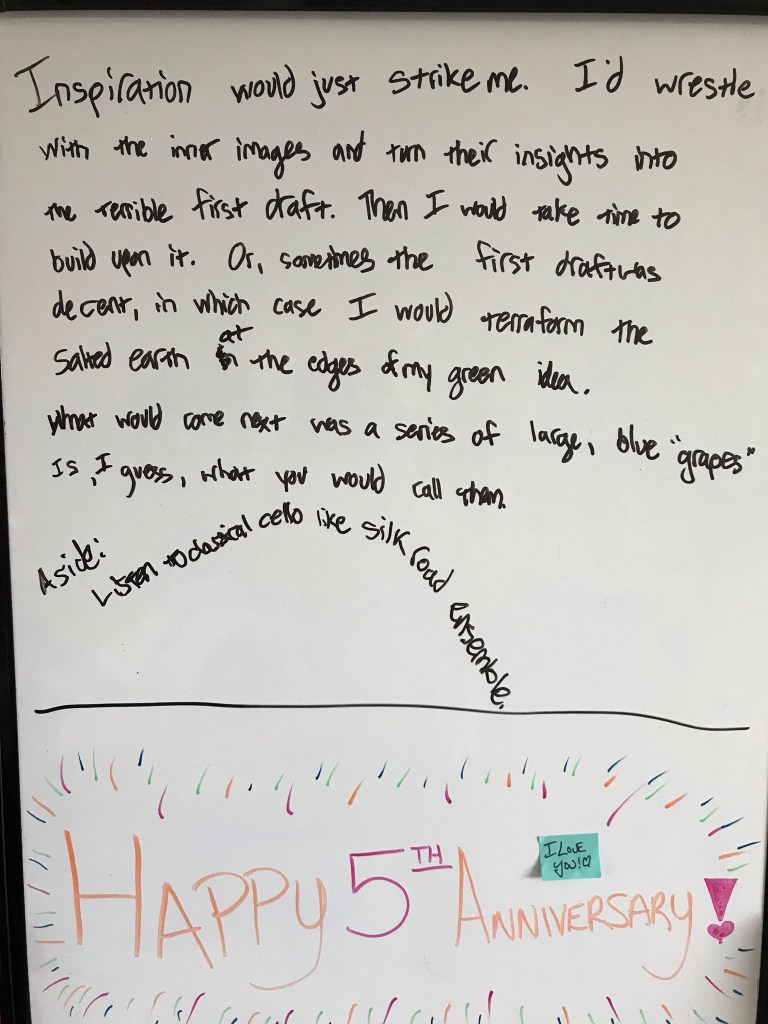
Inspiration would just strike me. I’d wrestle with the inner images and turn those insights into a terrible first draft. Then, later, I would iterate it. Or, sometimes, the first draft would be decent. Then, I would wade to the edges of my idea, building upon it right away. What would come next was a series of large, blue “grapes” — that’s what we called them, grapes — and inside the grapes were dozens of dangling yellow threads.

The threads lined the inside edge of the blue orb and they would wiggle. Some wiggled faster than others. I’d float inside, looking for the wiggliest thread. When I pulled one, a wormhole would open up and I would enter a state of flow. I would stay inside the grape for as long as it took. I’d look for the next thread, then I would be transported into a new passing grape. I’d spend hours swinging through the Hammer Veld.
Those were good times.
Once the fear moved in, fewer and fewer threads appeared. Threads that were ignored became rigid and stopped moving. We had to grab faster and faster before the threads became rigid and the portals closed. When the portals closed, a green light would appear in the corner of our vision. Then, we learned to ignore the green light while we made decisions about our threads. That meant even fewer of us made the cut. Only a few of us could choose quickly and accurately enough to move between a bunch of grapes in a session.
At first, we used our eyes to indicate which direction we wanted to move. Then, we developed the first headset with a brain scanner. The brain scanners controlled our avatars, that way our eyes could dart around when we were thinking. Still, some developers — like me — preferred to control our avatars with finger movements. I’d developed many VR experiences using this method. I’d also developed compulsive twitch in my hand from spending so much time in the tank.
To increase immersion, the float tank would give us the sensation of moving through space by engaging water jets that maintained our proximity from the edge of the grape. We were drifting around in shallow water, but we began to feel that we were moving through space. It felt like enlightenment at first, then it began to feel normal, then it felt like a crutch.
We were grape wranglers and gradually we began to feel that we might be as good as they said we were.
I’d pump some Bach or shamanic drumming into my headset and then I’d fly into the veld. Or, I’d just listen to my breath and heartbeat. Those sessions were intensely personal.
Sometimes we would jam together. An idea would spring forward and then we’d make a circle around a bonfire, or the sun, or the moon, or the Earth, or Mars. We would do this from anywhere in the solar system, in real time.
The new traditions were ancient ones, all to do with the cycles of the planets and their relationships to the sun. These rituals connected us. No matter who, or where we were, we were linked on special days during the Solar Festival. Through the practice of ritualistic theater, we became light as we moved to rhythms we created. Once VR access was declared a human right, we began to connect to one another across hemispheres and planets for these rituals. Now, millions of people came to the Solar Festival each season. This was our fifth year.
It still amazes me that the rituals were adopted so quickly. We didn’t resent the sun, and we didn’t worship it. We respected its power. We needed it. All living things needed it. Many millions enacted the ritual of becoming heavenly bodies as part of our new communal practice. Through rhythmic movement, we practiced balance, reminding ourselves of the connection of all known life to the sun. It was my favorite season of the year; it still is.
The sun was a natural center point for the new communal rituals. Humanity had practiced thanking the sun for centuries. Quantum technology had enabled us to gather from across the solar system, and the energy for this event came from the sun itself.
We created new rituals through play. We brought together artists and musicians and storytellers and experience designers, and we explored moments of symbolic action through improvised play that was co-developed with local communities. We collected all of this information and formed a democratic way for communities to decide what stayed and what went. There were thousands of rituals. It was like humanity celebrating itself. “This is not a religion,” we said at the beginning of the project. “This is a way to celebrate life together.”
I still felt strongly connected to the rituals, but these days I needed the real world. It was hard to make time for the real world as an Experience Director at the Mars Human Project, where most of my day was spent floating in a saltwater tank wearing VR goggles. I wasn’t the only crew member growing tired of virtual reality, but sometimes it felt that way. I missed the feeling of real grass and fresh water, and trees. I missed the sounds and smells of nature. Nature had crafted our minds and bodies, but now we made sterile environments for our minds, leaving our bodies behind. I knew we could do better.
To be continued.
JDF

 Trust The Thread